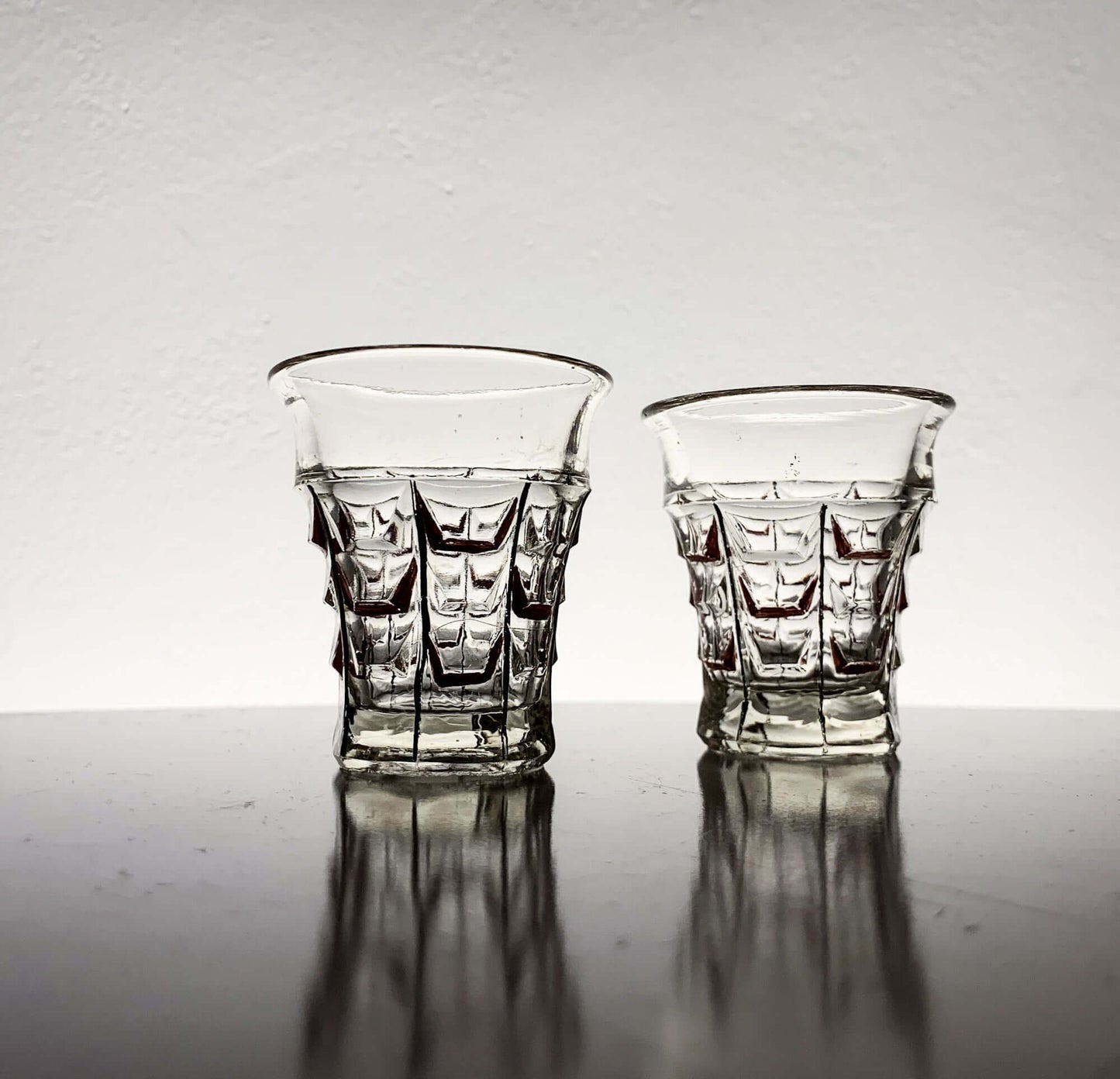


Riihimäen lasi | Pair of hand-painted shot glasses, 1930s
Riihimäen lasi | Pair of hand-painted shot glasses, 1930s
Typical shipping: Finland from €5.90 • EU €9–35 • Worldwide €19–60
Only one available
About the Glasses
A rare pair of vintage shot glasses produced by Riihimäen Lasi and documented in the company catalogue of boxed sets from 1938.
The glasses combine pressed geometric glass with delicate hand painted red and black decoration placed deep inside the cut pattern. The result changes constantly depending on light and angle.
The form itself feels distinctly prewar in character. Strong vertical lines, slightly widening rims, and thick faceted walls give the glasses an almost architectural rhythm uncommon in later Nordic glass.
Manufacturer
Riihimäen Lasi
Finland
Period
Documented in Riihimäen Lasi catalogue material from 1938.
Material
Clear pressed glass with hand painted decoration.
Dimensions
Height: 6 cm
Condition
Good vintage condition with visible traces of age and use consistent with the period.
Design Details
The faceted pattern creates layered reflections through the entire body of the glass. The hand painted red accents deepen the structure visually and bring warmth into the otherwise transparent form.
Even empty, the glasses remain visually active on a table. Reflections continue through the base and surrounding surfaces, especially under evening light.
Small variations in painting and glass texture are part of their original production character.
Use
Originally designed as shot glasses for snaps and liqueurs, though they also work beautifully as decorative cabinet pieces within collections of early Finnish glass.
Historical Context
Riihimäen Lasi was among the most important Finnish glass manufacturers of the early twentieth century. During the 1930s, the company produced a wide range of pressed and decorative glass that balanced practical use with increasingly modern geometric forms.
Pieces from this period often carry a distinctly different atmosphere from later Scandinavian modernism: more ornamental, more compact, and strongly tied to Art Deco influenced design language.
Continue exploring